
Helping Build New Habits To Tackle Covid-19 at Indiana University Campus
First Place Winner - This project aimed to help the IUPUI campus community adapt to new behaviors that promote hygiene and safety amidst the Covid-19 pandemic.
CHALLENGE SPONSOR OVERVIEW

The Covid-19 Challenge was sponsored by the School of Informatics & Computing at IUPUI as a means to focus on campus response to the pandemic.
MY ROLE
I worked closely with the other team member throughout the entire project duration. I helped conduct interviews, analyze findings and brainstorm solutions. I took the lead in the conceptualization and visual design of the application.
PROJECT DURATION
3 weeks - July 2020
AWESOME TEAM
Akash & Vaishnavi

THE SOLUTION
THE CHALLENGE
Influence Behaviors
Design an app that will help influence the behaviors of the campus community by informing, educating, and communicating about desired COVID-19 behaviors and building new habits.
. . .
RESEARCH
Design Process

Desk Research
Our focus was to develop a solution that could be implemented with minimum effort in a short duration. Since everyone nowadays owns a smartphone, our solution was built around a dedicated mobile application. We had this fact in mind as we began the research phase of this project.
Our desk research phase consisted of understanding the notion of habit tracking. We studied popular habit tracking applications to understand their design. We wanted to explore the concept of gamification and identify ways in which we could apply it to the design of this application. We majorly referred to the book "Actionable Gamification" by Yu-kai Chow.
Understanding Users
As we haven’t experienced campus life amidst the pandemic, our initial emphasis was on understanding the problems of students and faculty.
Initially, to understand our users' pain points, we interviewed two students over hour-long zoom calls to get a raw idea of their current mindset and struggles. These initial interviews enabled us to design a questionnaire that we circulated amongst the campus students. Additionally, we also circulated a questionnaire amongst the faculty to understand their workflows in the covid situation and issues they’re struggling with.
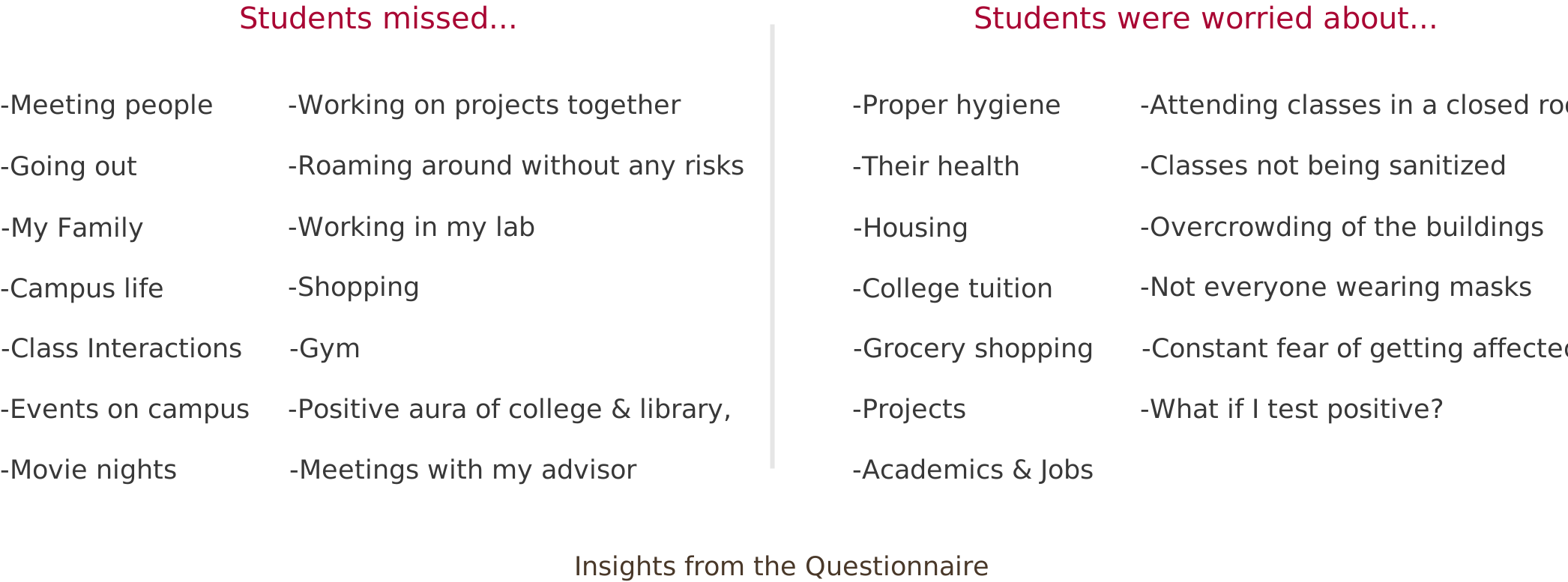
Once we received a fair amount of responses from the questionnaire, we categorized their responses in the form of a mood board to help us understand their mindset and empathize with them.
Personas
As we progressed in this phase of understanding our users, we noticed specific behavior patterns amongst students. Hence, we decided to list them as user types or personas. We came up with six distinct personas representing individuals affected by this pandemic. An individual may display characteristics of one user type under certain conditions and may switch to other user types as those conditions change.

Research Findings
After understanding the students' mindset, we wrote down key problems they are struggling with.
- As students are taking online classes, they are feeling homesick and less motivated to work
- Students are worried about others not wearing masks and following social distancing protocols
- Students are concerned about the overcrowding of campus buildings and routes
- Students are concerned about the sanitization of classrooms and labs
- Specifically, international students are concerned about procedures if they start showing symptoms
. . .
IDEATION & PROTOTYPES
Since we are designing for a problem we are currently facing, our focus was to devise a solution that could be implemented with minimum effort in a short duration. Since most individuals nowadays own a smartphone, our solutions are built around a dedicated mobile application.
This mobile app is not limited to only students or faculty. It's for everyone. All members including students, maintenance staff, faculty and desk staff at IUPUI can make this app a part of their daily lives.

Covid-19 Help And Information Centre
Initially, we discovered that several individuals were unaware of certain protocols to follow to reduce the spread of coronavirus. A potential reason for this may be the tremendous information overload related to COVID-19 throughout social media. We wanted to ensure that everyone is well-aware of precautions that need to be taken on-campus and on a personal level. So, we decided to categorize the information given in Indiana University’s Return To Campus Guide efficiently and easily.
What you should do every day has detailed stepwise guidelines for protocols such as Washing Your Hands, Basic Sanitation, Guidelines For Masks, Social Distancing, Isolation and Symptom Checking.
Information about COVID-19 contains facts related to the novel coronavirus from trusted sources.
COVID-19 Testing at IUPUI contains information related to testing services at Indiana University. This section includes information like Who Should Be Tested, How Do I Get Tested, What Can I Expect From The Test Results and What To Do If I’m Tested Positive. We believe that it would be helpful if this screen had a button that would enable the distressed students to connect with campus medical staff in case of emergencies.
Additionally, Need Masks & Sanitizers enables users to find places on campus where they can get masks, sanitizers & other related supplies if they ever run out of them.
Lastly, a Frequently Asked Questions section would help students stay updated with the latest important news on the campus. Here, we would provide them with categories that are already present on Indiana University's Fall 2020 website. We believe it would be efficient if we could open these pages in a web view within the mobile app.


Covid-19 Habit Tracker
It takes an average of 66 days to form a new habit. With the idea of habit tracking, we wanted to give our users a medium to help them include these new COVID-related habits in their daily schedules. This app will function similarly to a normal gamified habit tracker with some new features built around it.
The first feature is Time-Based Tracking (which is used prominently in several habit trackers today) This means that users can assign a specific time to a habit. So, if the user leaves their home at 8 am, they will assign this time to the first habit. As a result, they will get a push notification 5 minutes in advance to wear a mask and carry sanitizers before they leave their homes.
The second feature is Location-Based Tracking. Here, users can assign a specific location to a habit. Initially, we will ask the user for permission to save their home location. For example, for the second habit, the user will assign their home location to it. So, they will get a push notification to sanitize themselves whenever they reach home. Users will be able to assign only one tracking feature to a habit. Either time or location. Not both.
Mask Check Using Face Recognition
This feature will be a part of the Habit Tracker mentioned above. Here, users will receive push notifications randomly throughout the day reminding them to wear a mask. In the initial stages of this feature implementation, users can choose the "Yes" option from the notifications panel if they are wearing a mask.
We wish to take this a step further. In the ideal version of this feature, when users receive a push notification for a mask check, the selfie camera will automatically open up within the app and scan their faces for masks. A number of face recognition libraries are used in apps like Snapchat and Instagram. So, we believe implementing this feature won't be a burdensome task. Lastly, users can set the frequency of these push notifications through the settings menu.
Social Distancing Reminder
This feature will help users abide by the rules of social distancing. The concept is as follows. Whenever a user comes within a 6 ft radius of any other user for a duration of more than 15 seconds, the app will send a push notification reminding the user to maintain a safe distance. Users can further decide to silence the notification. Although there are a few technical challenges to implementing this feature, we believe that it will help users abide by social distancing rules.
Gamification Model
We wanted to make the experience of habit-building a fun one for our users. Gamification is a form of “extrinsic motivation,” it can be a very powerful tool for making it easier to change habits and keep ourselves motivated. Gamification helps you boost the “reward” aspect of your habit loops (cue → routine → reward), by giving you an extra prize for completing a good habit. In addition, Gamification creates a sense of “virtual progress”, so you get a stronger feeling of moving forward when you see yourself gaining points.
So, we decided to apply a Gamification Model to the features introduced above. The measurement metric we came up with is called "Immunity Points" Here's the logic. Users who complete all habits successfully in a day receive 10 Immunity Points. This is also the maximum number of points they can receive daily. However, if they fail to complete a single habit instance, 0.2 points will be deducted. (There may exist multiple instances for Mask Check and Social Distancing Reminder habits)
Once users collect a certain number of points, they can redeem those for a reward. Rewards could be in the form of discount coupons for cafeterias, and restaurants or offers on essential supplies like masks, sanitizers, medicines, stationery or groceries. We understand that this decision belongs to the respected officials, but we're sure that we could develop some form of arrangement with local businesses in Indianapolis and create a win-win situation for both parties.

. . .
LETS CONNECT!
 I'm available for full-time UX opportunities. Always happy to chat about your requirements. Feel free to email me at rodeakash@gmail.com

© 2026 All Rights Reserved. Built by Akash Rode. Images and content may be subject to copyright.